

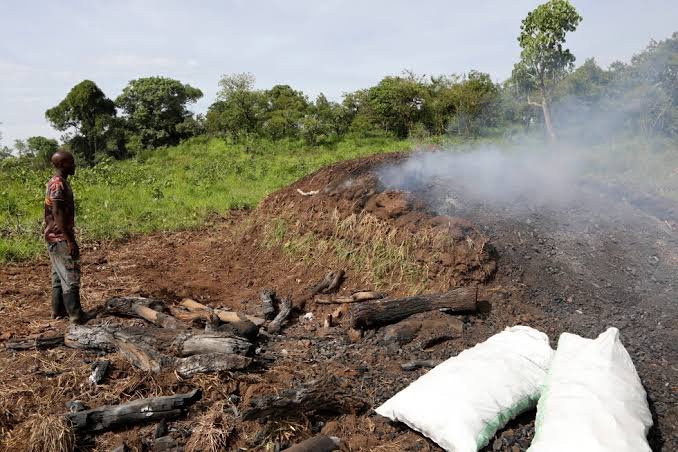
When Nate Africa Consulting conducted the Koboko District Climate Risk and Vulnerability Assessment (CRVA) earlier this year, our team engaged with district leaders, farmers, health workers, and local authorities across four subcounties. The conversations were direct: What threatens your ability to grow food? When do you lose cattle to drought? Why are the floods getting worse?
One conversation stood out. A local leader in the validation workshop held on 26 May 2026 raised an issue that does not appear in official trade statistics or government reports. South Sudan, he explained, is a major source of charcoal flowing into northern Uganda — not charcoal produced in Uganda and exported elsewhere, but the reverse. Charcoal imported from a country gripped by economic collapse and armed conflict, processed, and distributed through Kampala into the region.
We verified this through direct engagement with charcoal suppliers operating in Kampala. The narrative was consistent. This discovery reframes how we understand Koboko's climate vulnerabilities, and it exposes a critical blind spot in Uganda's climate adaptation planning.
The scale of the problem
Uganda's forests are disappearing at an alarming rate. Between 2001 and 2020, the country lost 918,000 hectares of tree cover, a 12 percent decrease since 2000. Charcoal production is a primary driver: by some estimates, six million tonnes of wood are annually transformed into 1.8 million tonnes of charcoal. The production method is destructive — producers often harvest whole trees from indigenous forests.
The regional pattern is severe. By 2023, the Acholi districts of Gulu, Nwoya and Omoro had lost a combined 2,800 hectares of forest cover, equivalent to 1.4 million tonnes of carbon emissions. These are irreversible losses happening in the zone adjacent to Koboko.
Where does the charcoal come from?
Official export data is obscured by informal trade networks and reclassification schemes. But fragmentary evidence points clearly to South Sudan. Uganda's imports of wood charcoal in 2023 show South Sudan with a share of 96 percent, valued at 428,000 US dollars. This reverses the typical narrative: Uganda is not exporting charcoal to Kenya. Uganda is importing it from South Sudan, often through Kampala distribution hubs, for consumption across the region including northern districts.
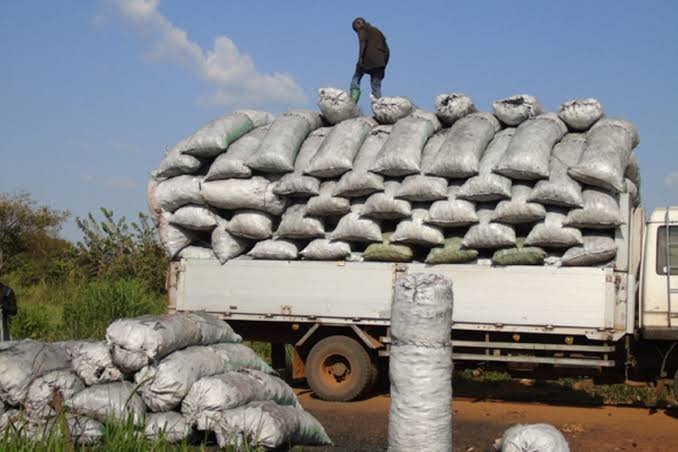
Armed actors profit. Civilians in South Sudan cut trees to survive. Ugandan traders profit from the arbitrage. And northern Uganda absorbs the climate consequences.
A report presented to the United Nations Security Council reveals how illicit trade in gold and charcoal, facilitated by military actors and informal networks, is funnelling millions into Kenya and Uganda. South Sudanese security forces are among key participants in the country's charcoal trade, engaging in production and transportation. Economic desperation drives the trade. South Sudan's economy collapsed. What remains is resource extraction.
The climate impact chain
Forest loss and other changes to land use account for around 23 percent of current human-caused carbon dioxide emissions — roughly 17 percent of the 100-year warming impact of all current greenhouse gas emissions. This is not a minor contributor. This is the second-largest source of warming after energy.
The mechanism in northern Uganda is visible in climate data. Tree felling for charcoal production has led to widespread deforestation, exposing several parts of the country to adverse climate change impacts, including drought in the north and northeastern parts and floods in the southwest.
For Koboko specifically, the CRVA documented a warming trend of 0.23 degrees Celsius per decade over the past 40 years. Precipitation is becoming more erratic, with intense rainfall events interspersed with dry spells. The district is experiencing both flood hazards in low-lying areas and drought stress in upland parishes. Deforestation amplifies both risks: reduced forest cover increases runoff velocity during heavy rains and reduces moisture retention during dry periods.
Why the South Sudan connection matters
Uganda's own charcoal trade is already heavily regulated, though poorly enforced. The 2004 East African Community Customs Management Act bans charcoal exports. Uganda's Forest and Tree Planting Act of 2003 requires sustainable harvesting. But South Sudan is outside this framework.
The same opacity that makes South Sudan's gold trade unrecordable applies to charcoal. A supply chain based in conflict and economic collapse is inherently unregulated. No forest management plan guides harvesting. No carbon accounting occurs. No restoration is required. And the consequences land in Uganda.
In Koboko, district officials and farmers are implementing adaptation measures with limited budgets. They are building water harvesting structures. They are promoting drought-resistant crop varieties. They are stockpiling fodder. All of this is necessary and important. But it addresses symptoms, not causes.
What the CRVA found
The Nate Africa team conducted 25 key informant interviews across Koboko District, including with district production officers, health workers, disaster risk managers, and local community development officers. We reviewed secondary climate and hazard data. We analysed sectoral impacts on agriculture, water, health, and infrastructure.
The consistent finding: Koboko's climate vulnerabilities are amplified by land degradation. Loss of tree cover reduces the district's adaptive capacity. Farmers in parishes with higher deforestation experience lower crop yields during dry years. Pastoral communities see grazing pressure increase where forest buffers have disappeared.
The charcoal supply chain was not a finding we anticipated. It emerged through structured dialogue with people who experience the impacts daily. A local leader made the connection explicit. Our follow-up verification with Kampala suppliers confirmed the pattern.
The implications for climate action
Uganda has committed to climate adaptation through the UNFCCC Paris Agreement. The LoCAL Facility, which funded this CRVA, allocates performance-based grants to districts for climate resilience investments. These are essential. But they are insufficient if drivers like the charcoal supply chain remain unaddressed.
Three interventions are needed:
Uganda should require charcoal imports to be tracked by source, volume, and carbon content. This is technically feasible but politically difficult. It requires regional coordination across Uganda, South Sudan, Kenya, and Tanzania, and enforcement mechanisms.
South Sudan's armed forces profit from charcoal because the state offers no alternatives. If livelihood options existed, extraction would decline. This requires external investment in conflict-affected regions, not just in Uganda.
Uganda's own charcoal regulations are weakly enforced. District Forest Officers lack resources. Strengthening the National Forestry Authority's capacity in border districts — Arua, Moyo, Koboko — would slow informal imports.
Why Nate Africa is raising this
Our role is to support districts like Koboko in understanding their climate risks and building resilience. But understanding requires naming the systems driving vulnerability.
The South Sudan charcoal trade is not inevitable. It persists because it is profitable, unmonitored, and unregulated. Awareness is the first step toward intervention. We are publishing this to signal what climate vulnerability assessment actually finds when conducted at district level with rigorous engagement.
If northern Uganda is to adapt to climate change, this supply chain must become visible, quantified, and addressed. The local leaders who raised this issue during validation understood the connection better than most policy documents. We are listening to them.